MorphBrain explores how molecular patterning could affect
brain growth and folding through differential growth. I implemented
reaction–diffusion components and compared SHH/BMP signalling conditions.
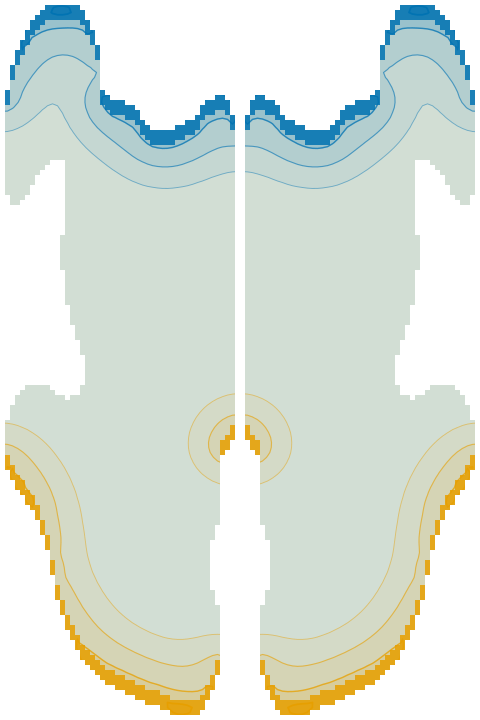
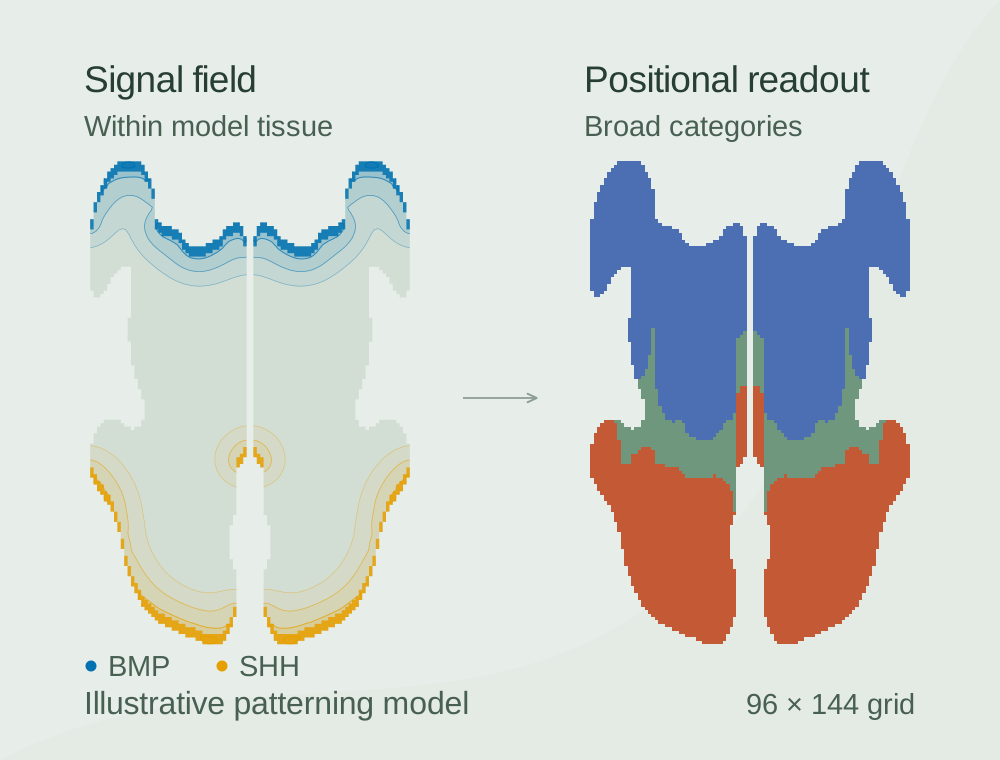
The public model demonstrates the patterning stage: move or remove a
source to see how the regions assigned by the model change.
Illustrative patterning model. Parameters are not calibrated to biological
measurements. The current demo does not yet couple patterning to 3D growth and folding.
Methods & sources
The original aim connects molecular patterning to differential-growth
mechanics, informed by Tallinen’s brain-folding work, with real atlas
geometry as the intended mechanistic outcome. Exploratory growth/mechanics
and separate atlas playback do not establish that outcome or a replication
of Tallinen. Presenting MorphBrain at UCL led to a supervised
research opportunity.
To reproduce the demo example, leave both source strengths at 1×
and remove BMP bilateral region 1 (either outermost handle).
Keep all six SHH source pairs. Run the condition and compare the
converged endpoints: dorsal identity changes from 48.8% to
45.6%, intermediate from 12.5% to 15.7%, and ventral stays at
38.7%. In this run, 3.2% of model tissue changes identity. These
are model outputs, not measured biological effects.
The solver starts both fields at zero and stops when each
field’s relative update is at most 10−4 and the
decoded identity holds for five consecutive qualifying steps. A
1,000-iteration cap rejects unsettled runs. Solver iterations
represent numerical relaxation, not developmental time.
The biological context includes
Jessell (2000)
and
Zagorski et al. (2017); these support the qualitative mechanism, not the chosen
decoder parameters. The independent atlas view uses CC0
population-average GW21–36 surfaces from the
dHCP fetal surface atlas. The atlas is a separate data reference, not a response to the
molecular intervention. Further numerical details are available
in the demo’s evidence panel.
Can measurements distinguish diffusion from clearance?
Synthetic parameter recovery: a separate 1D
study examined which measurements distinguish diffusion from
clearance. After source shutoff with zero-flux boundaries, the
total-amount time course constrains clearance but contains no
diffusion information. In the noiseless seven-reading
comparison, one spatial arrangement left roughly as many
plausible parameter pairs as a local trace; reversing the
arrangement was much less informative. Recovery benefits from
knowing the generating model, source and calibration. This is a
within-model result, not biological validation or a re-analysis
of experimental assays.
This separate 1D experiment compares total amount, a local trace
and spatial observations. It does not calibrate the public 2D
demo.